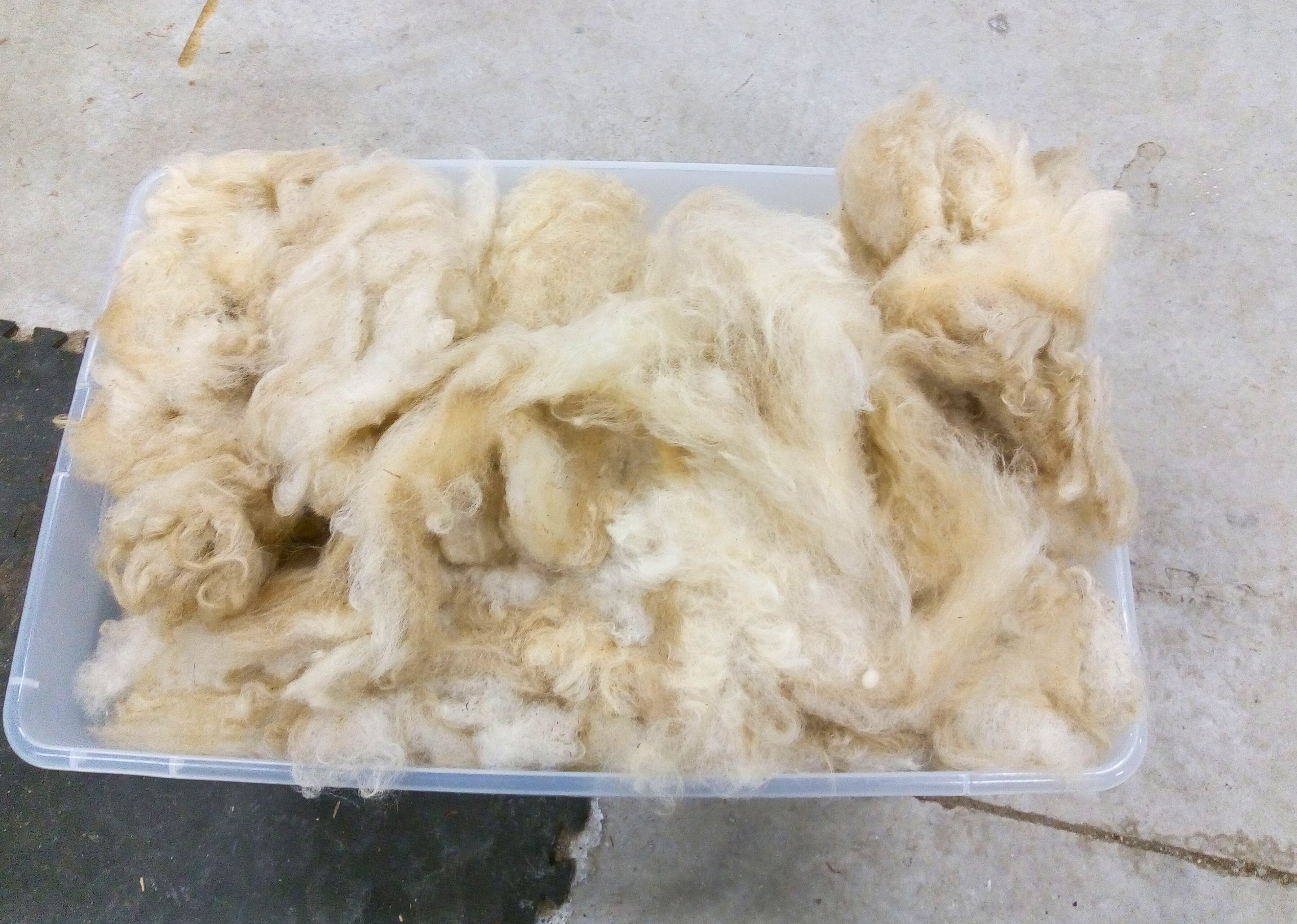
I unexpectedly received some Valais Blacknose sheep fleece as a generous gift from a new shepherd, introduced by a mutual friend who knew I was a handspinner and weaver. These sheep are famously cute; just Google “cutest sheep in the world” to see them. Our friend texted me, asking if I wanted the fleece, and I quickly replied, “yes.” A few days later, I received the beautiful wool fleece bundles and started thinking about processing fleece into roving for spinning. Last year, my friend and I planned to tour a local fiber mill, and now there’s a real incentive to do it. In my excitement, I realized I have many questions about the next steps to get the best outcome from processing this precious fiber at my local mill. Here’s what I learned!
1) Skirting the fleece is an important step!
Skirt the fleece – What does skirting mean? It’s not about dressing your fleece with a tutu but removing the less desirable parts that come with raw fleece, such as vegetative matter (VM)/hay, tags (feces), and second cuts (shorter pieces of fleece from shearing an area twice). Skirting is a crucial step in preparing your fleece for the mill. Most mills charge based on the incoming fleece’s weight, so skirting removes unusable waste like dirt and debris, reducing the weight and cost. Skirting a fleece takes time and energy, and it’s best to avoid windy days to prevent your fleece from blowing away—ask me how I know! In the future, consider making a skirting table, a frame with a screen that lets dirt and debris fall through. There are several YouTube videos on how to make your own like this one by Shepherd Industries .

2) Make a list of questions to ask the mill prior to sending your fleeces for processing.
- What is the minimal and maximal staple length their equipment can handle?
- Staple length is the length of lock or fiber from butt to tip.
- Is there a minimum amount of fiber that is required to get processed ?
- My local mill is a small operation and will work with small batches even if you only have one fleece to process.
- What breeds of sheep the mill tends to process?
- This turned out to be a very important question for me because Valais blacknose sheep is not a common breed here in Canada and this breed tends to have a long staple length. One of my fleeces could not be processed because it had a staple length greater than 8 inches.
- What is the turn around time for processing your fleece?
- The estimated time in my case will be 3 to 4 months which is fine since I still have fiber I can spin and it gives me time to brainstorm ideas . It could be worse considering some mills have a year turnaround time.
- What processing services do they provide?
- My options were limited to making a roving or batt or felted into sheets. This mill had only a picker, carder and felting machine onsite. Yarn can be done but it is sent to another mill. Some mills have services include dyeing and blending with other fibers.
Another useful tip I found is to prewash your fleece to save on costs, as approximately 30% of the dry weight is due to lanolin. If your fleece is very dirty, mills may charge an additional fee to clean it.
Since this is my first time processing a fleece, I’m sure I’m only scratching the surface of the topic. What I’ve learned so far has made me respect the labor-intensive process of converting fleece into yarn even more. While I know how much time it takes to make yarn, I’ve discovered there are many additional steps required to transform raw fleece into a spin-ready preparation. I admire handspinners who process their own fleece and might try it myself in the future. For now, I appreciate the opportunity to support local mills. Have you ever bought fleece and processed it yourself, or have you sent it out to a mill? Feel free to comment below.
This is so cool! I had no idea what was involved with the process. I love seeing the journey! Looking forward to more. 🙂
Thanks Jessica! I will definitely keep everyone posted on the process. 🙂