It feels wonderful to be getting back into the rhythm of making again. Even though I haven’t been sharing much about my projects during the latter part of 2025 and the start of 2026, I’ve still been busy creating. Life gets hectic sometimes and can pull me in all sorts of directions, making it easy to lose my footing. I really miss putting my thoughts on paper and connecting over my love for making. So, I’ve decided to jump back in—no guilt, just a fresh commitment to why this blog exists: to feel connected again and see where the journey takes me in the making community.
What Have I Been Up To?
Lately, weaving and spinning have captured my heart, especially working with locally sourced wool. If you’ve followed my earlier posts, you know I’ve been bringing raw fleece to a local fiber mill, Wool 4 Ewe, and getting it processed into roving to spin on my wheel. I spent much of last year and even this year spinning that fleece into yarn for weaving projects. One big goal was to spin enough yarn to use as weft for a couch throw I made for someone. After finishing that project on my larger 45-inch Leclerc Fanny loom, I felt inspired to keep spinning for more throws—and maybe even bigger projects like a twin-size coverlet measuring about 60 by 80 inches.
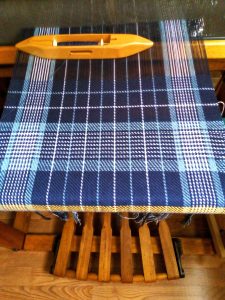
Handwoven throw in progress on my 45inch Leclerc Fanny Floor loom
For my previous project, I used an 8/2 cotton warp set at 16 ends per inch, as recommended in a book about traditional coverlets by Helen Jarvis. The single-ply wool yarn I spun was about DK weight. After wet finishing and drying, the blanket had a scrumptious drape—cozy for chilly nights, and light enough to hang nicely on the couch.
Current handwoven throw in progress. Weaving with 2 ply handspun yarn.
On my smaller antique loom, I’ve been weaving hand towels using Venne organic cotton 8/2 yarn, a new discovery for me. I’ve been mixing purples in a shadow play pattern from a Nov/Dec 2021 Handwoven magazine issue. I often wonder about the difference between regular cotton and organic cotton. Honestly, after washing and drying on low, these towels feel so much softer in hand. I’ll definitely revisit Venne organic 8/2 cotton yarn—it seems worth the extra splurge!
Knitting has been a bit slower lately. I’ve been working on finishing a pair of socks using hand-dyed yarn from a swap partner (who dyed it herself!). I tried using the yarn in different projects, but didn’t love how it looked, so I boldly ripped it out and kept hunting for the right pattern. This lace pattern I’m working with now lets the yarn’s color variation shine without pooling too much in any one spot.
Current handknit socks in progress using hand-dyed yarn
Looking Ahead: Goals for 2026
My main goal for 2026 is more spinning and weaving—no surprise there—especially using natural, locally sourced fleece in new weaving projects.
I also want to get back into knitting sweaters. I’ve spun yarn for sweaters before but sometimes get distracted by quicker projects. Although prepping samples and doing gauge swatches isn’t my favourite, I know it’s important for getting the right fit. Right now, I have some alpaca yarn from a local fiber mill that I hope to use. I have my eye on a few patterns, but I’m not rushing—finding the perfect sweater pattern for that yarn is part of the fun!
I’m sure there will be more projects popping up and joining my to-do list, since I like to keep things flexible and let my creativity lead the way. Until next time, happy crafting—and I’ll be back soon to share more adventures!
Wow, I can hardly believe it’s been a year since I embarked on this adventure of documenting my creative journey with Sweet Stitching Crafts. What a whirlwind it’s been—full of excitement, growth, and a few moments of disbelief. But those unsure moments are far outweighed by the overwhelming joy this blog has brought into my life.
When I first started, I had a few specific goals in mind. One of the most important? Putting myself out there—something I don’t naturally do. I’ve always been more comfortable with my thoughts and my own space, partly because of that universal fear of being judged. But I decided that this blog was going to be my way of challenging myself, pushing into uncomfortable situations, and seeing where it led me. And I love what I’m seeing! It feels so freeing to express myself creatively, whether I’m crafting or writing, and I hope to keep pushing myself to embrace even more freedom in the year ahead.
Another goal I set was to embrace all my crafts! Yes, all of them! Spinning, weaving, embroidery, knitting, crocheting, rug hooking—the list goes on. Sometimes I joke that I’m cheating on one craft with another, but the truth is, I love them equally. People might say that focusing on one thing would help me master it, and sure, becoming an expert in one craft has its appeal. But that’s not why I craft. I do it for the way it makes me feel—it lifts my mood, builds my confidence, and melts away stress.
I also started this blog with the hope of encouraging others to dive into crafting. I’ve met so many people who say they wish they knew how to craft but are too afraid to try. My advice? Just go for it! Pick any craft that intrigues you and give it a shot. If it’s not for you, move on to the next one. Crafting is such a personal journey, and there’s no wrong way to approach it. To those of you who’ve reached out to tell me that the blog has inspired you, thank you. Your messages mean the world and remind me that my crafting is making a positive impact!
So, what’s next for Sweet Stitching Crafts? Plenty more of what you’ve already seen! I hope to take you along on field trips (fingers crossed!), share helpful tips, and keep you updated on ongoing projects. I still need to share my experience with my Valais Blacknose sheep fleece that I sent to Wool4Ewe for processing, as well as the refurbishment of my “new to me” floor loom. I’m also toying with the idea of adding a book review feature, since I love reading about crafts and often enjoy book recommendations from other bloggers.
If there’s anything you’d like me to explore more deeply, feel free to drop a comment below. I truly appreciate each and every one of you who’ve spent time with me on this journey. Here’s to another year of crafting and connecting!
I came across an old weaving pattern from the January/February 1994 Handwoven Magazine called “Winter Lichen Towels” by Jean Scorge. It featured two main aspects I wanted for my new project: 1) the twill color weave technique, and 2) a geometric/block design. These were not my usual preferences, but I was eager for a challenge and something different. However, the most significant challenge I faced with this project was creating a fresh color scheme to give it a modern twist.
Understanding color theory wasn’t easy for me, despite being creative. Picking colors that worked well together to enhance my projects didn’t come naturally. I usually preferred darker shades like black, navy, and charcoal because they felt comfortable to me. Mixing colors with similar darkness seemed safe, but it often resulted in losing the design’s impact. Even though I knew about primary colors and how they combine to form complementary, secondary, and tertiary colors, I still lacked confidence in choosing colors wisely. However, watching Gail Defrusne’s video “The Value of Values” changed my perspective. Her approach of considering values, or the darkness or lightness of colors, helped me select colors and plan designs more efficiently and effectively.
updated Winter Lichen handwoven towels
The original colors in the pattern were sage green, white, and charcoal. While I liked each color individually, the combination felt dated with this pattern. Instead of relying on the color wheel for inspiration, I chose to visualize the pattern in grayscale, akin to pencil shading. In the future, I plan to take a picture of the pattern and apply a black and white effect for a quicker reference. Then, I organized my stash of 8/2 cotton into dark, medium, and light tones. I opted for navy as the dark color, denim blue as the medium tone, and white as the light tone. The next step involved deciding where to place these colors within the geometric design to highlight the contrast between dark and light. In the border section of the pattern, I alternated colors every two rows (picks of weaving) to draw attention to this detail. Alternating navy and white, which offered the most contrast, seemed the logical choice. Seeing the prewashed finished towels, following the original weaving pattern, I’m thrilled with the result! It brings a refreshing update to the older pattern.
For the next two towels, I’m changing the weaving pattern to incorporate more color blocking. One towel will feature a solid block of navy, while the other will alternate navy and white every four rows (picks). I’m hoping that this weaving style will give the almost vintage pattern a modern twist. Check out this sneak peek video below to see how it’s coming along!
Exploring color more deeply, especially from a value perspective, has been really fulfilling. It’s pushed me out of my comfort zone of sticking to dark colors and choosing hues solely based on their position on the color wheel. I’m excited to apply this new approach to color planning and selection in all my future projects. How do you typically select colors for your projects? I’d love to hear your thoughts! Please comment below.